Download resources

Book a visit

Menu Icon

Programme Overview

Since its inception, Krea has focussed on building an institution with exceptional research calibre. The PhD programme is designed to strengthen the creativity and scholarship of research scholars who are expected to engage in deep and impactful research. The programme takes a holistic approach, strengthening foundational knowledge through coursework and encouraging critical thinking to produce original scholarship during the course of the doctoral programme.

Why Pursue a PhD at SIAS?

The PhD programme is designed to be a holistic research experience that places equal importance on learning within and outside the classroom. Here are few reasons on why the programme stands out:

Phd SIAS Mentors

Mentors

Highly experienced and supporting faculty with veteran researchers, specialists, and experts from the field

Phd SIAS Careers

Careers

Prepared not just for a career in academics but also for the corporate world, with excellent placement possibilities 

Phd SIAS Ecosystem

Ecosystem 

Opportunities to work with Research Centres on various topics of applied research and public policy

Phd SIAS Resources

Resources

A world-class digital library and high-end research labs
Phd SIAS Networking

Networking

Networking opportunities with faculty from renowned international institutions

Phd SIAS Support

Support

Tuition fee waiver, accommodation support, and a monthly fellowship

Phd SIAS Funding

Funding

Support for national and international conferences for full-time PhD students

Research areas

Research is core to Krea and drives everything we do at the university. Research here finds itself at the intersection of extensive, interdisciplinary and interwoven thinking. There are diverse areas to choose from across Arts, Humanities, Social Sciences and Sciences. The pedagogy is strategically designed to provide scholars with the best available theory, practice, and methodology for executing their research. 

Biological Sciences

Major

Minor

Chemistry

Major

Minor

Computer Science

Major

Minor

Environmental Studies

Major

Minor

History

Major

Minor

Mathematics

Major

Minor

Politics

Major

Minor

Physics

Major

Minor

Psychology

Major

Minor

Sociology and
Social Anthropology

Major

Minor

Biological Sciences
  • Ecology and Evolution (e.g., Variation in life history strategies, plant-animal interactions, butterfly behaviour and disease ecology) 
  • Neurobiology (e.g., Computational neuroscience, epilepsy and traumatic brain injuries)
  • Structural Biophysics (e.g., Bio-NMR, protein structure and dynamics, modelling)
  • Systems Biology (e.g., Prospective health – the determinants of baseline health, and bacterial engineering)
  • Organic Chemistry- Organic synthesis, Electrosynthesis, Photochemical Synthesis, Electro-photochemical Synthesis, Electrocatalysis

  • Computational Chemistry- Modelling Weak Interactions, Molecular Confinement, Nanoscale Systems, Protein-Ligand Interaction, Reaction Mechanisms

  • Molecular Spectroscopy- Molecular Photophysics, Time-resolved spectroscopy, Raman spectroscopy and Microscopy

  • Inorganic Chemistry- Inorganic Materials synthesis and Characterization, Nanomaterial synthesis, Heterogeneous catalysis, thermocatalysis and electrocatalysis using inorganic and nanomaterial composites

  • Algorithms and Complexity- Approximation Algorithms and Parameterized Algorithms

  • Computational Logic, Formal Methods and Programming Languages- Application of formal methods and artificial intelligence to software systems and cyber-physical systems, Logic and foundations of Computer Science, Programming Language Semantics, Verification and Formalisation of Proofs

  • Quantum Computation- Quantum Algorithms and Quantum Information Theory

  • Atmospheric and Climate Sciences- Aerosol-monsoon interactions, Monsoon projections, Middle atmospheric dynamics, Thermosphere-Ionosphere coupling

  • Space Physics and Aeronomy- Thermosphere-Ionosphere coupling, Ionospheric studies, Space weather

  • Remote Sensing- Optical cameras and spectrometers for atmospheric studies, Radar signal processing, Satellite data fusion

  • Political Ecology

  • Social-Ecological Systems

  • Conserving biodiversity in peopled landscapes

  • Natural Resource Governance

  • Climate policy- Climate responsibility and finance, Climate performance

  • Sustainability Science- Planetary boundaries and human development

  • Sustainability Policy- Global sustainable transitions, Energy transition on a finite planet

  • Research Areas: Early Modern, Modern and Contemporary South Asia

  • Specialisations: Transport History, Military History, Colonial state and archives 

  • Research Areas: Premodern South Asia

  • Specialisations: Medieval and Early Modern history, Early India, Regional History and Area Studies, Comparative Literature, Religious Traditions and Identities, Indian Ocean and Maritime networks, Money and Exchange, Textual Traditions and Literary studies, Intellectual History 

  • Research Areas: Art and Material History

  • Specialisations: Architectural History, Material and Visual Culture 

  • Research Areas: World History

  • Specialisations: Medieval Europe, West Asia and the Mediterranean, Sassanians and Byzantines, Frontiers and Empires, Textual and Numismatic studies

  • Research Areas: Indian Medieval History and History of Science in India

  • Algebra, Combinatorics, and Representation Theory:

  • Specialisations: Group Cohomology, Homological Algebra, Noncommutative Ring Theory,  Algebraic and Topological Combinatorics, Number Theory, Representation Theory of Algebraic  Groups and Lie Algebras.

  • Applied Mathematics and Analysis of Partial Differential Equations:

  • Specialisations: Fluid Dynamics, Spectral Theory, Theory of Homogenization, Regularity Theory  of PDEs, Calculus of Variations.

  • Topology and Geometry:

  • Specialisations: Combinatorial Group Theory, Geometric Group Theory, Hyperbolic Geometry,  Low-Dimensional Topology, Mapping Class Groups, Teichmüller Theory.

  • Quantum Optics and Quantum Information (Theory and NV-Centre-based experimental studies)
    Specialisations: Quantum Computing, Quantum Sensing / Magnetometry, quantum cavity arrays, quantum phase transitions, and statistical physics, superconducting qubits

  • Condensed Matter Physics and Materials Science
    Specialisations: Strongly correlated electronic systems, low dimensional and geometrically frustrated magnets, Materials discovery under extreme conditions (High Pressure & High Temperature), Biological molecules under pressure, Spectroscopy (Raman and Solid state NMR/NQR down to 4 K), superconductivity

  • Particle and Astroparticle Physics

  • Specialisations: Neutrino physics and astrophysics, Beyond Standard Model (BSM) physics, dark matter and dark energy

  • Major Research Areas and Sub-Fields
    The discipline’s research and teaching span the full breadth of contemporary political inquiry. Our work is empirically grounded, conceptually rigorous, and attentive to the layered textures of politics in India, the Global South, and the wider world.

  • Democracy, Institutions, Law and Public Policy

  • Core Questions: How do democratic institutions function? How do rights, justice, and accountability shape political life? How do states design and implement policy?

  • Sub-fields / Themes:

  • Democratic practices, accountability, governance, and public service delivery.

  • Law, constitutionality, citizenship, rights, and justice in plural societies.

  • Public policy in India and comparative policy analysis (welfare, inequality, inclusion,social protection).

  • State–society relations and institutional interactions.


  • Identity, Culture, Inequality & Social Movements

  • Core Questions: How do social identities shape politics? How do cultural forms and collective action challenge or sustain power?
    Sub-fields / Themes:

  • Caste, religion, ethnicity, minority rights, marginalisation, social exclusion.

  • Social movements, civic action, mobilisation, democratic participation from below.

  • Intersectional politics: gender, sexuality, technology, labouring bodies, and social categories.

  • Cultural politics: belonging, identity, minority cultures, social imaginaries, urban cultures.


  • Comparative Politics, Global Politics & Transnational Processes

  • Core Questions: How do political systems differ across regions? How does global interdependence reshape power and justice?

  • Sub-fields / Themes:
    Comparative politics of the Global South and cross-regional institutional analysis.
    International politics, world order, globalisation, transnational flows, global justice.
    Political economy of development: economic transformation, inequality, and historical development trajectories.


  • Urban, Regional & Special Politics/Political Economy of Space

  • Core Questions: How do space, economy, and infrastructure shape political power and social life?

  • Sub-fields / Themes:

  • Urban politics, spatial governance, city planning, urban histories and imaginaries.

  • Regional economic geography: infrastructure, mobility, circulation, and rural–urbanlinkages.
    Spatial inequality, class, and the political economy of development.

  • Politics of Technology, Media, Data and Contemporary Global Challenges

  • Core Questions: How do digital technologies, media systems, and global crises transform democracy and citizenship?

  • Sub-fields / Themes:

  • Digital politics: big data, platforms, surveillance, technology-mediated social relations.

  • Media, representation, classification, and power in cultural and political life.

  • Global crises and planetary politics: environment, pandemics, ethical challenges of globalisation.

  • Political Theory, Philosophy and Intellectual Histories

  • Core Questions: What concepts organise political life? How do ideas, norms, and histories shape our understanding of politics?

  • Sub-fields / Themes:

  • Political theory and political philosophy: justice, democracy, freedom, rights, identity,state.
    History of ideas and intellectual history, with strengths in Global South, non-Western and decolonial traditions.
    Critical theory and normative political analysis: ethics, power, authority, collective action.

  • Clinical and Counselling Psychology, Cultural Psychology, Social Psychology, Political Psychology

  • Developmental Psychology and Neuroscience

  • Cognitive Psychology, Computational Psychology, Neuropsychology

  • Visual Cognition, Linguistic Cognition, Psychophysics, Psycholinguistics

    Methods: Qualitative, Quantitative, Field based, Experimental, Computational, Psychophysical, and Neuroimaging methods or any combinations thereof.

  • Our specialisations and interest areas cut across Economic, Political, Environmental, Sociology and Anthropology, Gender Studies, Science and Technology Studies (STS), Media Studies, Cultural Studies, Urban Studies and AgrarianStudies. We work at the intersections with other disciplines, including gender, history, economics, political science and environmental and urban studies. We offer a mix of thematic as well as regional and transnational opportunities and the teaching in the department is grounded in a strong tradition of fieldwork-based research.The department has faculty with diverse academic backgrounds and strong regional, national and international links offering a wide-range of cutting edge topics. We’re happy to welcome students from all over the world to our vibrant, welcoming and inclusive department. The research clusters below are indicative of the broad range of issues that we are interested in.


  • Capital, Value, Infrastructure and Economic Growth
  • Markets, Informality, Work and Livelihoods
  • Economic sociology, Gig/platform economy
  • Gender and labour
  • Ecology, migration and development
  • Agrarian Economies and Ecologies
  • Rural Economies and Development
  • Human nonhuman relations
  • More than human Nature
  • Land, Water, Forests and Ecological Harms
  • Effects of climate change on mental health, migration and social justice
  • Conservation policies and resource distribution
  • Gender and sexuality
  • Political Violence, Subjectivity, and the Psychosocial
  • Gender, Masculinity, and the Politics of Power
  • Literature, Emotion, and Alternative Archives of Conflict
  • State, Sovereignty, Authoritarianism and Democratic Social Movements
  • Identity and Representation
  • Caste, Coloniality and the Ontologies of difference
  • Border studies
  • Media Propaganda; Disinformation and Fake News
  • Political Economy of Media in India
  • Social Media and Political Polarization / Populism
  • Digital Media and Diaspora; Transnational Media Practices; Diasporic Politics
  • Visual Anthropology; Audio Visual Media and Cultural Change In India
  • Emerging technologies, digital labour, knowledge production
  • Cultural studies of technological/scientific communities
  • New Media Studies
  • Pop culture studies
  • Urban Land Relations
  • Ecologies of Construction
  • Urbanization Processes
  • Historical trajectories of Regional Economic Development
  • Agrarian studies
  • Sociology of Labour and Skill Formation
  • Expressive cultures, music, traditional knowledge systems
  • Digital humanities, community engaged archives
  • Anthropology, philosophy and history of the senses, place and body
  • Music cognition, embodied cognition, cognitive linguistics.


  • Geographical areas covered:
  • South Asia and South East Asia, including countries like Bangladesh, India, Singapore, China. The United States and South Asian Diaspora in West Europe

Categories of study

Full-time

Entails coursework, teaching, and dissertation, and scholars are to reside on campus (during term time) for the entire duration of the programme.

Part-time / Faculty 
Improvement Programme (FIP)

Designed for professionals looking to further their research interests while also enhancing career prospects. Scholars are to stay on campus for the first term of the programme and visit campus as and when suggested by the advisor and the Doctoral Committee (DC).

Programme Structure

Year 1 - 2

Coursework

Assigning advisor(s)

Formation of the Doctoral Committee (DC)

Formulation of research problem

Inputs and approval from the Discipline-specific-advisory group (DAG)

Basic training on relevant techniques/methodologies

Detailed presentation to the DC for approval 

Year 3 - 5

Research/Field Work

Presentations in conferences

Publishing in Journals

Coursework

Assigning advisor(s)

Formation of the Doctoral Committee (DC)

Formulation of research problem

Inputs and approval from the Discipline-specific-advisory group (DAG)

Basic training on relevant techniques/methodologies

Detailed presentation to the DC for approval 

Research/Field Work

Presentations in conferences

Publishing in Journals

Important

The Doctoral Committee will conduct a progress review for every candidate at the end of each academic year.
For candidacy, scholars must complete the required coursework and get necessary approvals on their research proposal within the time period stipulated by the DC.
All full-time PhD scholars are required to work as Teaching Assistants for 2 courses every academic year, from the 2nd year onwards.

Research Labs

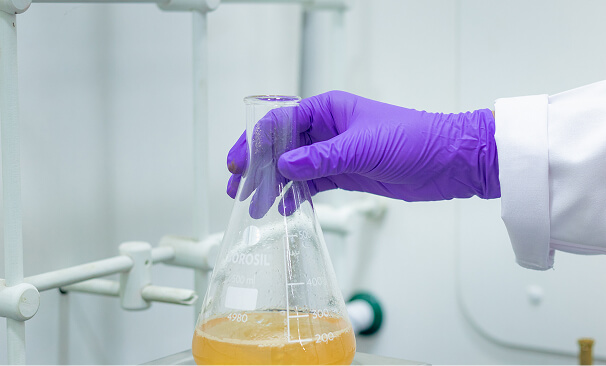
Krea provides state-of-the-art research facilities including laboratories, libraries, and access to online databases to its doctoral scholars.

Biological Sciences Lab

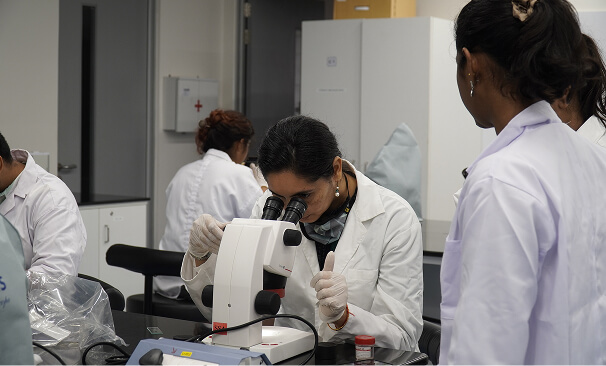
The Mazumdar-Shaw Biological Sciences Laboratory at Krea houses instruments that support a wide range of procedures in the biological sciences—zoological and botanical specimen preparation and observation; biochemical preparation, purification, and analysis of samples; molecular cloning techniques; multiplexed immunological assays; spectroscopic and calorimetric measurements; ecological observation and measurement; and data analysis, inference, and interpretation.

The Computational Chemistry Lab at Krea University provides rigorous and forward-looking training in modern molecular modelling and data-driven chemical discovery.

The Data Science Lab provides GPU-enabled workstations for hands-on machine learning where scholars can explore data, build models, and run experiments using JupyterLab/Anaconda Navigator with popular Python and R libraries (PyTorch, scikit-learn, etc.). For workloads that require more power, our on-campus HPC cluster offers high-performance computing and GPU acceleration, ideal for deep learning training and other computationally intensive tasks.

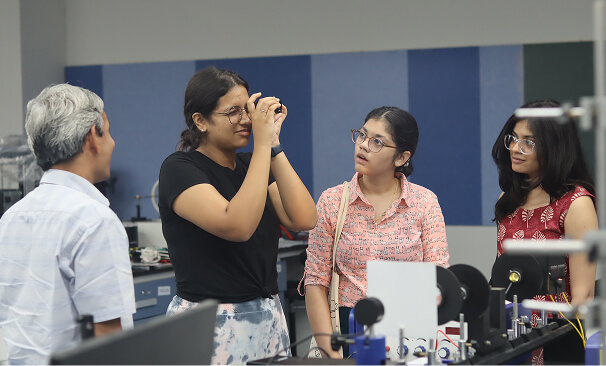
Physics lab offers several unique experimental facilities, such as a Dobsonian reflector telescope, a 3D printer, an optical table, a gamma spectroscopy kit (Indosaw), a spectrofluorometer (Horiba Scientific), a UV–Vis spectrometer (LABINDIA), and an analytical IR spectrometer (Bruker).

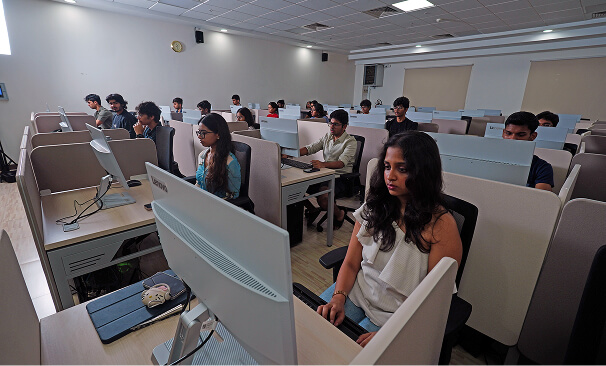
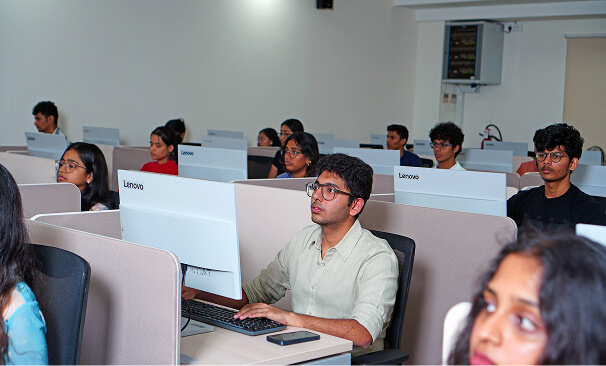
Scholars have access to two modern computer laboratories with over 100 high-performance workstations that support hands-on instruction and structured lab sessions alongside coursework.

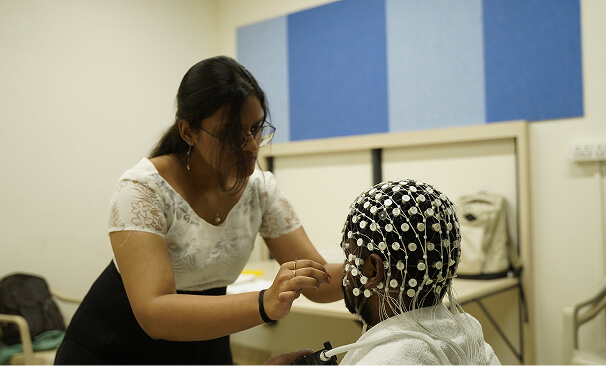
The Behavioural Sciences & Neuroimaging Lab is dedicated to advancing research in human cognition through a multidisciplinary approach. The lab is equipped with advanced tools such as Electroencephalography (EEG), Near-Infrared Spectroscopy (NIRS), Virtual Reality (VR) systems, eye-tracking technology, and a range of instruments for behavioural measurement.

Know Your Mentors

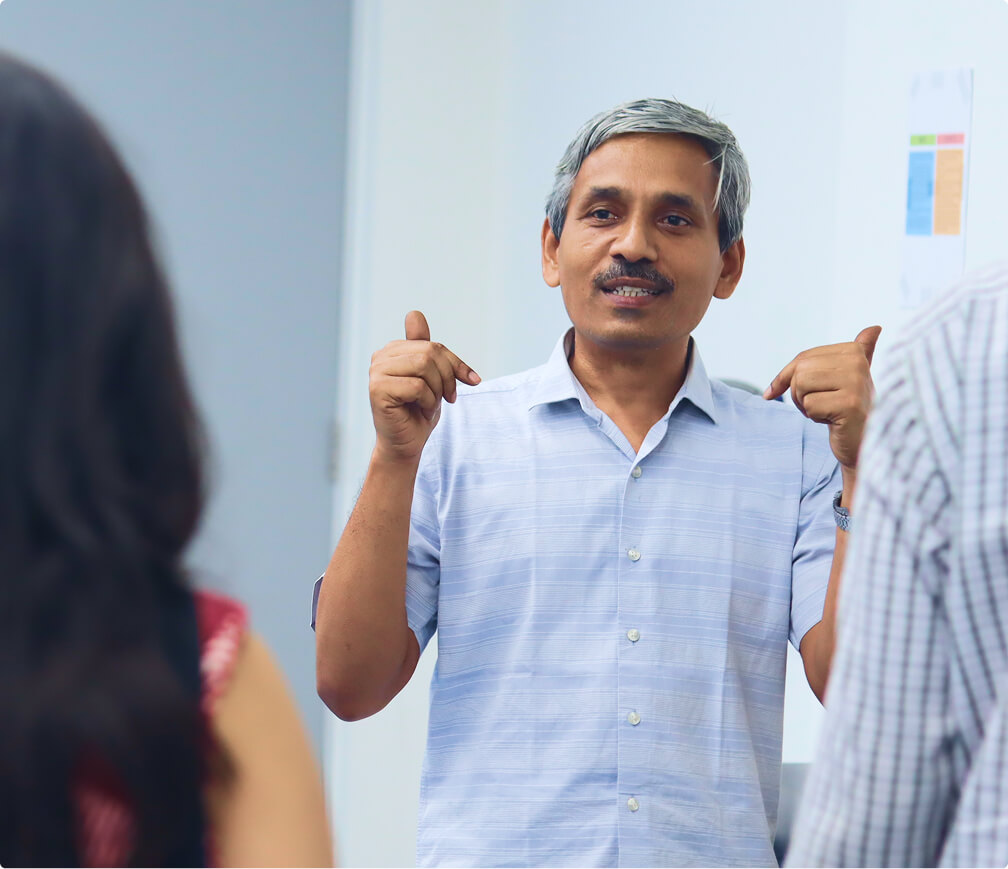
Faculty members are drawn from the best universities across the world and are a fine blend of academic expertise, combined with robust research credentials. Each year over 100 peer-reviewed publications published, combining rigorous scholarship and industry-linked expertise to guide PhD research across discipline

PHD SIAS mentors

In the Spotlight

 Student stories of of aspirations, milestones, passion and perseverance

SIAS

SIAS PhD Scholar Presents Paper at IASH Conference, University of Edinburgh

Aravind R, an SIAS PhD scholar in Sociology presented a paper titled ‘Digital Queer Intimacies in the City: Pleasure, Labour and Ghettoisation’aste to fuels in the journal Science.

SIAS

SIAS alum co-authors an article published in Mongabay

Trisha Putturaya, SIAS alum, has co-authored an article titled From Diversity to Monotony: Ecological Communities Are Homogenising with Professor Guha Dharmarajan, Professor, Biological Sciences, SIAS. The article has been published in Mongabay.

SIAS

SIAS UG student and faculty Publish Research Paper with Springer

A research paper titled Modeling Recurrent Neural Networks in Serial Recall Paradigm with Dynamic Self-excitation, co-authored and presented by Purvikalyani Prasannah, UG Cohort of 2023–27, SIAS,

Research stories that are curious, critical and committed

SIAS

SIAS PhD Scholar Presents Paper at IASH Conference, University of Edinburgh

Aravind R, an SIAS PhD scholar in Sociology presented a paper titled ‘Digital Queer Intimacies in the City: Pleasure, Labour and Ghettoisation’aste to fuels in the journal Science.

Shining spotlight on faculty achievements

SIAS

SIAS alum co-authors an article published in Mongabay

Trisha Putturaya, SIAS alum, has co-authored an article titled From Diversity to Monotony: Ecological Communities Are Homogenising with Professor Guha Dharmarajan, Professor, Biological Sciences, SIAS. The article has been published in Mongabay.

 Student stories of of aspirations, milestones, passion and perseverance

SIAS

SIAS UG student and faculty Publish Research Paper with Springer

A research paper titled Modeling Recurrent Neural Networks in Serial Recall Paradigm with Dynamic Self-excitation, co-authored and presented by Purvikalyani Prasannah, UG Cohort of 2023–27, SIAS,

Current scholars

The pathway to becoming an able researcher seeks a blend of curiosity, critical thinking, perseverance, resilience and to top it all, a knack of handling uncertainty, and the Krea PhD scholars are all of these and more. They are driven with a singular aim to contribute to the welfare of humanity through academia, research, and industry.

Phd SIAS current scholars

Research Ecosystem at Krea

The Campus Experience

The 40-acre green and sustainable campus in Sri City, is situated right in the heart of an Integrated Business City. Located 70 km from Chennai, the campus hosts state-of-the art infrastructure, tech enabled classrooms, cutting edge labs, expansive cafeteria, diverse sports facilities, a world class library, green spaces, medical centre, convenience store and much more.

Phd SIAS campus experience

Why study
at krea

Why study

at Krea

"Understanding the intricate and interconnected relationship between everything that surrounds us is of utmost importance if we aim to gain a comprehensive understanding of human beings as a species.

Achieving this level of understanding is not possible through a single discipline, but requires an interdisciplinary approach - which is precisely what Krea University offers. The impressive range of expertise that Krea faculty members possess sets the tone for a synchronised harmony that is truly captivating. As I perused some of the works of Krea professors, I was struck by the depth of knowledge and the sheer dedication they bring to their fields. It is evident that pursuing a doctoral degree at Krea University will require a great deal of hard work and effort, but the rewards are well worth it"

Turzo Nicholas Mondal

Cohort of 2024

Why study

at Krea

video preview

Ready to Apply?

Take your first step into the world of pivotal 
interdisciplinary research