












Download resources
Book a visit
Full-time and part-time PhD programmes across finance and management streams, from the pioneers of finance learning, research, and training in Asia.
The PhD programme at IFMR GSB trains scholars to become thought leaders capable of producing impactful research and contributing to academia, industry, and policy-making. With a strong legacy dating back to 1982, the programme effectively blends structured coursework with advanced research, ensuring robust training in both theoretical and applied domains. Its interdisciplinary approach exposes scholars to diverse functional areas of management such as economics, finance, marketing, and human resource management, and thereby enables them to address the critical challenges of businesses and public policy in emerging economies.
The PhD programme is designed to be a holistic research experience that places equal importance on learning within and outside the classroom. Here are few reasons on why the programme stands out:
Highly experienced and supporting faculty with veteran researchers, specialists, and experts from the field
Prepared not just for a career in academics but also for the corporate world, with excellent placement possibilities
An excellent platform to showcase work at the annual research symposium
Opportunities to work with Research Centres on various topics of applied research and public policy
A world-class digital library and the latest databases on the world economy and corporate annual reports
Networking opportunities with faculty from renowned international institutions
Tuition fee waiver, accommodation support, and a monthly fellowship
Support for national and international conferences for full-time PhD students
The Data Science & Information Systems area focuses on applied research, aimed at improving the decision-making capabilities of businesses across various domains. The area consists of faculty members having expertise in information systems, big data, responsible AI, statistical and predictive modeling, optimisation and heuristic algorithms, and signal and image processing. Research interests of faculty members in this area includes Optimisation, Vehicle routing, Heuristic algorithm, Transportation, and Supply chain operations, Statistical and predictive modeling, Large-scale multiple hypothesis testing, Brain imaging, False discovery control, Simulation of random matrices, AI/ML in practice, Signal and image processing, Manufacturing, Diagnostics and prognostics, Health and well-being.
The Economics area focuses on teaching, rigorous research, and consulting. Besides offering foundational courses in microeconomics, macroeconomics, statistics, econometrics, and mathematical economics, faculty members in the Economics area also teach both graduate and doctoral-level courses in Development Economics, Game Theory, Advanced Econometrics, Financial Inclusion, International Business, Labor Economics, Public Finance and Policy. The department has a rich legacy in applied economic research, and its faculty members always strive to conduct rigorous, evidence-based, and policy-relevant research. Faculty members actively publish papers in journals of global repute. Various courses offered by the area impart necessary skills to help PhD scholars think critically and conduct high quality research. Faculty members conduct research on a wide range of topics starting from applied development economics particularly, poverty alleviation, inequality, regional development, financial inclusion, livelihoods, education, health to agriculture, applied game theory, political economy, climate change, and labour economics.
The faculty members in this area pursue research on a wide range of topics that include corporate social responsibility (CSR), bankruptcy reforms, gender quota, Environmental, Social, and Governance (ESG), corporate innovation, market microstructure, climate finance, behavioural finance issues, time series modelling, which includes forecasting value at risk, and more. The faculty members challenge existing theories and develop new theories through their research. The department also organises an international research symposium on Finance and Economics (RSFE) every year. The symposium has received papers from more than 20 countries in the last few years. The department also publishes the peer-reviewed journal, Journal of Emerging Market Finance (categorised as “B” as per ABDC journal ranking) that focuses on cutting-edge research on the theory and practice of finance in emerging markets.
The marketing faculty have published several research papers in reputed journals listed in ABDC A* and A categories, along with case studies featured in Ivey Publishing and Harvard Business Review. Their research reflects a diverse and interdisciplinary orientation, blending core marketing theory with emerging domains. A strong emphasis is placed on consumer behaviour, particularly in understanding decision-making, brand evaluation, and ethical marketing practices. Their work also extends into service marketing, sustainability, and socially responsible consumption. Additionally, the faculty engage with real-world business challenges through applied case research, focusing on strategy, entrepreneurship, and sectoral transformation.
The Operations area is dedicated to reimagining how organisations design, manage, and sustain processes within increasingly volatile global environments. The approach is uniquely centered on sustainable operations, driven by the belief that modern efficiency is inseparable from environmental and social responsibility. They lead critical research into product life cycles, focusing on e-waste management, biomass and agri-food supply chains, and the vital intersection of business and human rights. By prioritising these frontiers, we develop resilient systems that ensure long-term viability for both industry and the planet.
Complementing this mission is the emphasis on behavioral operations, examining how human judgment and decision-making influence sustainable outcomes. By integrating psychological insights with rigorous statistical methods and empirical research, the gap is bridged between technical design and human action. This framework generates impactful insights, empowering organisations to achieve high-performance standards while fostering an equitable, ethical, and sustainable future for society.
The area of organisational behaviour and human resource management focuses on advancing research on individuals, teams, and organisations to understand and create effective workplaces. The OB-HR faculty pursue research on a wide range of topics such as leadership, personality, vocational psychology, employee well-being, sustainable HRM, public sector transformation, and the changing nature of work and HR processes across development and corporate sectors in the era of technological transformation. Our faculty’s research draws on interdisciplinary perspectives and employs diverse methodological approaches such as interviews, psychometric testing, quantitative surveys, and field studies. The area is committed to developing theoretically grounded and empirically rigorous research that contributes to management scholarship as well as management practice and policy.
The Strategic Management, Entrepreneurship and Public Policy area provides a vibrant, interdisciplinary PhD platform that bridges rigorous scholarship with real-world impact. The faculty combine cutting-edge research with extensive industry, policy, and entrepreneurial experience to mentor scholars addressing critical challenges in emerging economies.
Core research strengths and broad focus areas include strategic and technology foresight, alliances, microfoundations of strategic capabilities, behavioral strategy, AI strategies and governance, international business, entrepreneurship, institutions, corporate governance, sustainability, innovation, and the Indian Knowledge System.
Students receive tuition waiver and stipend for four years. Extension up to one year may be granted, following review by the Dissertation Committee.
Students are required to do coursework which is a blend of in-person and hybrid lectures and return to campus for end-of-year 1 examination and comprehensive examination, and proposal, synopsis, and thesis defense.
Combination of Core & Area level PhD courses, MBA courses
Independent Research Study
Comprehensive Examination
Formation of Doctoral Committee
Proposal Presentation
Periodic progress report and Public Seminar
Thesis Presentation
Synopsis & Thesis submission
External Review
Viva- Voce Examination
Final Thesis Submission
Combination of Core & Area level PhD courses, MBA courses
Independent Research Study
Comprehensive Examination
Formation of Doctoral Committee
Proposal Presentation
Periodic progress report and Public Seminar
Thesis Presentation
Synopsis & Thesis submission
External Review
Viva- Voce Examination
Final Thesis Submission
The alumni of the PhD programme have assumed positions as faculty in prestigious academic institutions, and also various other significant roles across corporate organisations, think tanks and more.
Some of the organisations where IFMR GSB PhD alumni work today
Ashoka University
Dr B R Ambedkar School of Economics University, Bengaluru
BITS Pilani, Hyderabad Campus
Center for Development Studies
Great Lakes Institute of Management
Gulati Institute of Finance and Taxation, Trivandrum
IIM Amritsar
IIM Indore
IIM Kashipur
IIM Shillong
IRMA
Madras School of Economics
Mahindra University
Rajagiri Business School
The Loyola Institute of Business Administration
Research institutes, think-tanks and corporates
Centre for Excellence in Fiscal Policy and Taxation
CRISIL
Deloitte
Ernst & Young
ICICI
Institute for Human Development
SCOPE International
Faculty members come with decades of experiences across academic and industry, combined with robust research credentials.
Gogireddy Naga Malleswara Reddy, IFMR GSB PhD Scholar, presented a research paper titled ‘Contemporary Trends and Policy Dilemmas in Rooftop Solar Adoption in Kerala’
Pratibha Jain, IFMR GSB PhD Scholar, presented a research paper titled ‘Joining by Chance, Leaving by Choice: A Dual-Theory Exploration of Rural Development Professionals’ Journeys in Nonprofits in India,
Mugdha Kinhikar, an IFMR GSB PhD Scholar, has been selected as a mentee for the Earth System Governance (ESG) Mentoring Initiative 2026.
Research stories that are curious, critical and committed
Mugdha Kinhikar, an IFMR GSB PhD Scholar, has been selected as a mentee for the Earth System Governance (ESG) Mentoring Initiative 2026.
Shining spotlight on faculty achievements
Gogireddy Naga Malleswara Reddy, IFMR GSB PhD Scholar, presented a research paper titled ‘Contemporary Trends and Policy Dilemmas in Rooftop Solar Adoption in Kerala’
Student stories of aspirations, milestones, passion and perseverance
Pratibha Jain, IFMR GSB PhD Scholar, presented a research paper titled ‘Joining by Chance, Leaving by Choice: A Dual-Theory Exploration of Rural Development Professionals’ Journeys in Nonprofits in India,
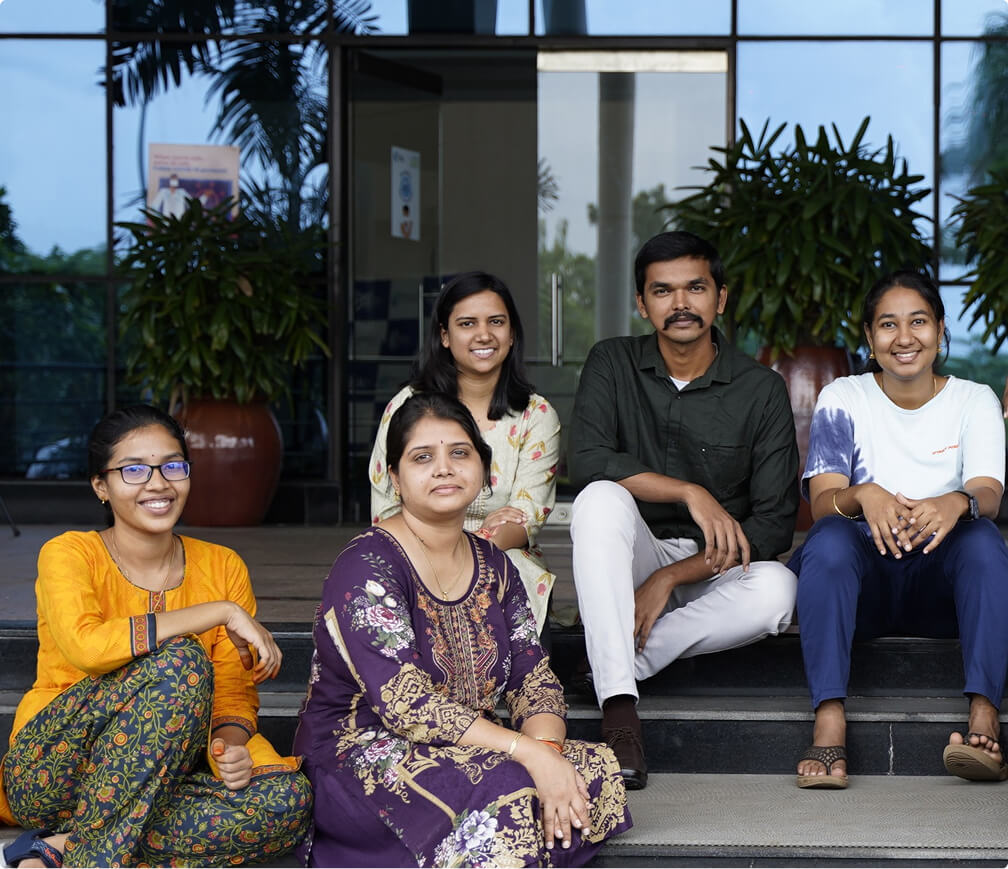
The pathway to becoming an able researcher seeks a blend of curiosity, critical thinking, perseverance, resilience and to top it all, a knack of handling uncertainty, and the Krea PhD scholars are all of these and more. They are driven with a singular aim to contribute to the welfare of humanity through academia, research, and industry.
The 40-acre green and sustainable campus in Sri City, is situated right in the heart of an Integrated Business City. Located 70 km from Chennai, the campus hosts state-of-the art infrastructure, tech enabled classrooms, cutting edge labs, expansive cafeteria, diverse sports facilities, a world class library, green spaces, medical centre, convenience store and much more.
| Name | Area | Title of Thesis | Year Awarded |
|---|---|---|---|
| N Chandrasekaran | Finance | Market Structure and Financial performance – A study of the Indian Cement Industry during 1971-86. | 1990 |
| G Ramachandran | Finance | Behaviour of Share Prices – A Statistical Analysis | 1991 |
| K Lakshmi | Finance | Financial Performance of Diversified Companies – A strategic analysis. | 1991 |
| Uma Subbaraman | Economics | Exchange Rate Economics: Micro Analysis of India’s Exchange Rate Experience | 1994 |
| S Manjula | Finance | Working Capital Management: A case study of fertilizer industry in India | 1995 |
| L V Ramana | Finance | Initial Public Offerings in India: Analysis of their performance and pricing | 1997 |
"My journey at IFMR GSB was transformative, providing a collaborative environment
that helped me grow as a researcher during my PhD programme. The institution offered a rigorous academic curriculum and fostered a culture of innovation and critical thinking. The unparalleled faculty support and collaborative research opportunities shaped my academic trajectory. IFMR GSB truly focuses on the quality of your research work and provides a platform for aspiring scholars to thrive. I am grateful for the invaluable experiences and opportunities that have become the foundation of my academic career.”

“The PhD programme in the area of Finance at IFMR GSB is one of the finest programmes in our country.
The coursework gives us a foundation in theoretical and empirical tools required for research in the area. A faculty pool with vast experience and passion for research keeps you motivated throughout. Lively interactions and their constant support makes IFMR GSB the best place to pursue a PhD.”
“My PhD journey at Krea University has been an enriching experience, marked by unwavering faculty support,
a peer inspired research environment, and access to exceptional library resources. I found research advisors who were not only immensely knowledgeable but also exceptional mentors. With their guidance, I received the opportunity to present my research papers at Harvard University, Monash University, IIM Bangalore, among others.”
Let’s help you take the first step into the Kreaverse. We encourage you to explore the various facets of the admissions process in-depth, and reach out to us in case of any queries. We look forward to supporting you in any way we can.